
November 4, 2026
Specifying an IP67 Inclination Sensor for Rail Vehicles and Mobile Platforms
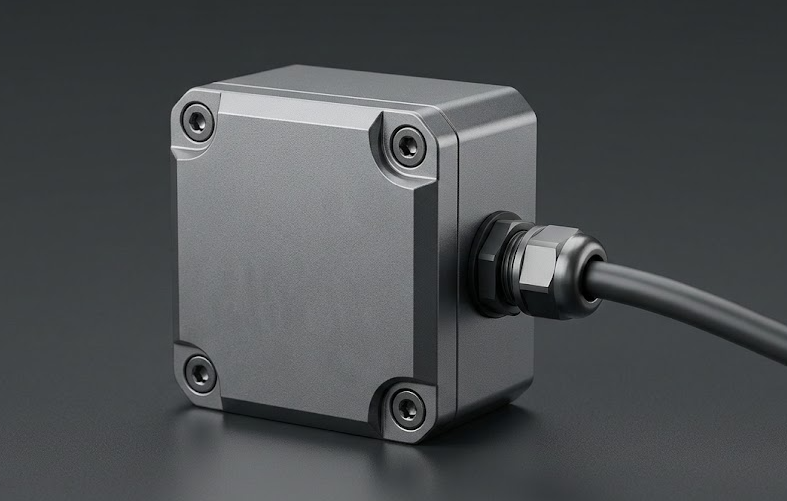
Tilt does not often make it onto the list of variables that engineers worry about — until a platform refuses to level, an access machine locks out mid-cycle, or a rail vehicle body leans further than the design intended. At that point the inclination sensor becomes the component everything else depends on. Selecting one is less about chasing the finest accuracy figure and more about matching the device to the environment it will actually live in.
Start with environment, not resolution
Outdoor equipment is washed by rain, sprayed by pressure cleaners, buried in construction dust and vibrated continuously. That reality sets the first two specifications. An enclosure rating of IP67 means the housing is dust-tight and survives temporary immersion, which is what field equipment genuinely needs. An aluminium enclosure contributes the second requirement: mechanical rigidity, dimensional stability across temperature, effective electromagnetic shielding, and a heat path away from the sensing element. At 0.4kg with an 80 × 75 × 57.5mm footprint, a unit in this class is light enough for moving structures yet robust enough for bolt-on mounting.
Operating temperature completes the picture. A range of −25°C to +85°C covers cold-climate start-up on mobile equipment as well as summer heat inside a cabinet near a traction converter. Specifying a narrower range because the datasheet price looks attractive is a common cause of winter field failures.
Analog or switching output?
This decision shapes the whole control architecture. An analogue output delivers continuous angle information to a controller, which then decides what to do. A switching output does the deciding inside the sensor: the device changes state when a preset threshold is crossed, and the controller simply receives a digital signal.
There is a strong case for the switching type in safety and interlock functions. It removes latency from software polling, keeps the threshold set at the sensor where it is visible and verifiable during commissioning, and continues to work even if the upstream controller is in a fault state. Settable switching thresholds also let one hardware variant serve several machine models, which is a real advantage for OEMs managing spare parts inventory.
Accuracy in context
An accuracy figure such as ±2.5° over a measurement range of ±10° sounds modest next to laboratory instrumentation, and for the intended applications it is entirely appropriate. Level control on a lift platform does not require arc-minute resolution; it needs repeatable detection of a tilt condition before the condition becomes dangerous. In practice, repeatability and long-term drift matter more to users than absolute accuracy, because drift generates nuisance trips and lost working hours.
Do not overlook EMC
Rail vehicles and construction machinery are electrically hostile. Traction drives, inverters, contactors and radio equipment all couple noise onto cables. A sensor declared to meet EMC requirements behaves predictably in that environment; one without such qualification may trigger false outputs when motors start, and this class of intermittent fault is notoriously expensive to diagnose. Asking for the EMC standard the product was tested against is a reasonable question, and a supplier should be able to name it.
Typical applications
l Lift platforms and aerial work platforms. Level control and out-of-level interlock, allowing motion only within safe limits.
l Construction equipment. Chassis attitude monitoring, stabiliser interlocks, and automatic levelling of the working attachment.
l Rail vehicles. Rail vehicle tilt control and body attitude monitoring, where a robust, sealed inclinometer with a defined temperature range survives years of service.
l Position switching. Detection of hatches, ramps and access doors reaching their end position, replacing mechanical limit switches that wear and need adjustment.
Practical installation guidance
Mount the sensor on a machined, flat surface and treat the mounting face as part of the measurement chain: paint overspray, uneven gasket thickness and loose fasteners all introduce installation error that no factory calibration can compensate for. Route the cable separately from power conductors, secure it against vibration, and provide a drip loop so that water runs away from the connector rather than into it. Finally, verify the switching threshold on the installed machine rather than on the bench — the difference between the two is where most commissioning surprises come from.
Specified carefully, an IP67 inclination sensor is a fit-and-forget component. Specified casually, it becomes the most complained-about part on the machine.