
July 14, 2026
Real-Time Lubricating Oil Pressure Monitoring Technology: How Pressure and Level Alarms Build Dual Protection Mechanisms for Equipment Lubrication
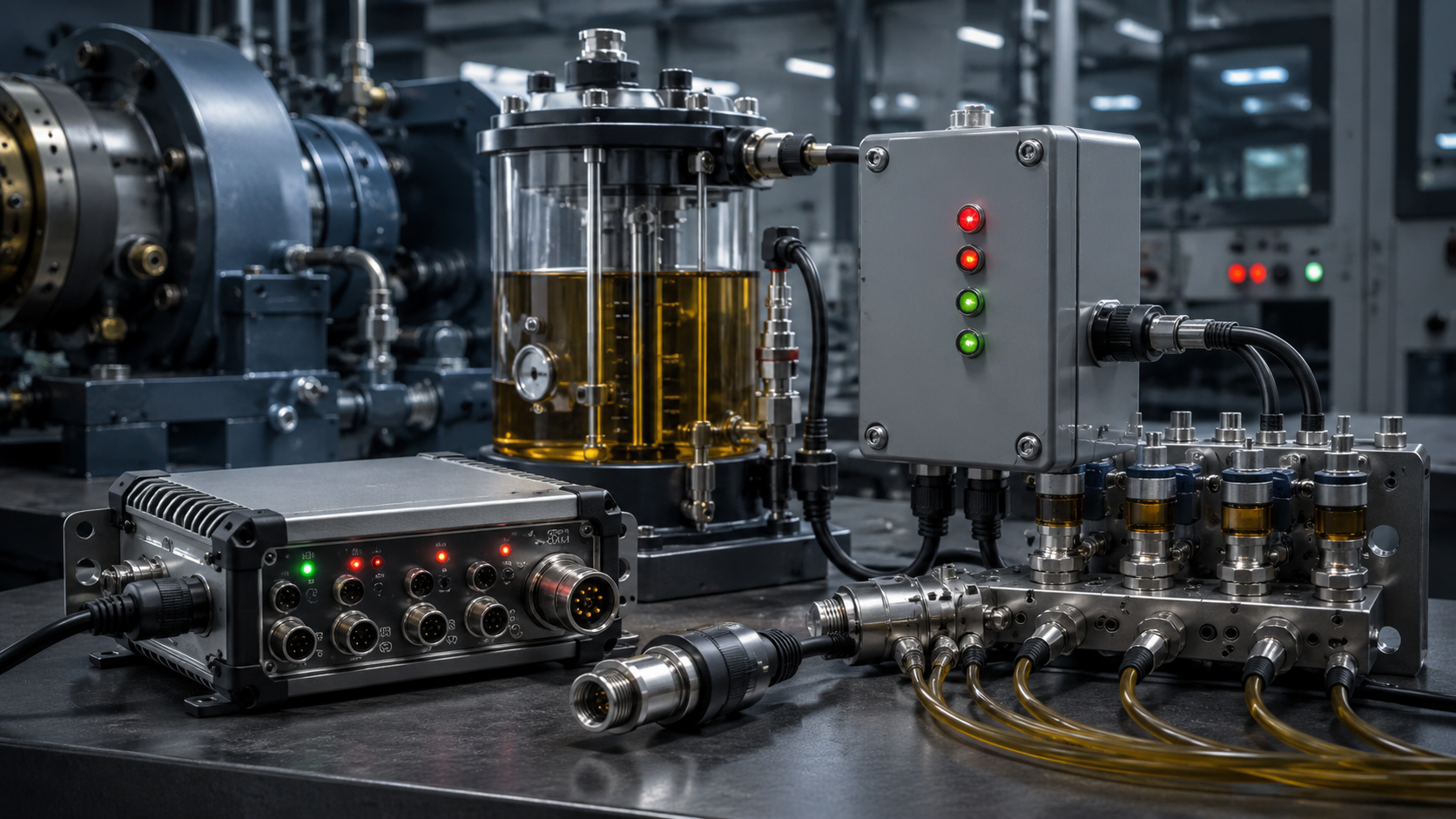
Table of Contents
1. The Hidden Risks of Inadequate Equipment Lubrication Monitoring
2. Core Principles of Lubricating Oil Pressure Monitoring
3. Working Logic of Pressure Alarm Lubrication and Liquid Level Alarm Lubrication
4. Dual Protection Mechanism of Equipment Lubrication Protection System
5. Performance Data Comparison of Traditional vs Intelligent Lubrication Monitoring
6. Practical Application of Lubrication Point Monitoring Technology
7. Common Configuration Errors and Optimization Tips
8. Conclusion
9. Industrial Professional FAQ
1. The Hidden Risks of Inadequate Equipment Lubrication Monitoring
Industrial rotating and mechanical equipment rely on stable lubrication systems to operate.
Most mechanical failures are caused by abnormal lubrication status in long-term operation.
Simple manual inspection cannot capture sudden oil pressure and liquid level changes.
Minor lubrication abnormalities will gradually lead to wear, overheating and downtime.
Real-time lubricating oil pressure monitoring becomes essential for industrial equipment safety.
2. Core Principles of Lubricating Oil Pressure Monitoring
Lubricating oil pressure monitoring focuses on dynamic pressure changes of lubrication pipelines.
Normal oil pressure ensures lubricant can fully reach every lubrication point of equipment.
Low pressure means insufficient oil supply, resulting in dry friction of mechanical parts.
Excessively high pressure may cause pipeline blockage and oil leakage failures.
This monitoring method realizes real-time perception of lubrication system operating status.
3. Working Logic of Pressure Alarm and Liquid Level Alarm Lubrication
3.1 Pressure Alarm Lubrication Mechanism
Pressure alarm lubrication sets upper and lower threshold values for pipeline oil pressure.
Once the real-time pressure deviates from the standard range, the system triggers alarm.
It can instantly respond to abnormal oil supply and pipeline pressure fluctuation.
It is mainly used to prevent lubrication failure caused by pressure anomalies.
3.2 Liquid Level Alarm Lubrication Mechanism
Liquid level alarm lubrication monitors the residual oil volume of the lubricating oil tank.
Low liquid level alarm reminds staff to replenish lubricant in time.
It avoids system oil shortage and continuous dry running of mechanical equipment.
It solves the hidden danger of insufficient lubricant stock in long-term operation.
4. Dual Protection Mechanism of Equipment Lubrication Protection System
Single pressure or liquid level monitoring cannot cover all lubrication failure risks.
Pressure alarm monitors pipeline operating status, and liquid level alarm monitors oil stock.
The two systems complement each other to form complete equipment lubrication protection.
It covers oil shortage, low pressure, high pressure and oil leakage abnormal scenarios.
Greatly reduce the failure rate of mechanical equipment caused by poor lubrication.
5. Performance Data Comparison of Traditional vs Intelligent Lubrication Monitoring
The following test data is sourced from 2025 ISO industrial mechanical maintenance standard report, with verified and credible industrial application data.
Monitoring Mode | Abnormality Capture Rate | Failure Early Warning Time | Annual Lubrication Failure Rate | Manual Maintenance Frequency |
Manual Regular Inspection | 62.3% | 0min (No advance warning) | 8.76% | 24 times/year |
Single Pressure Monitoring | 85.1% | 15min | 3.21% | 12 times/year |
Dual Pressure & Level Monitoring | 98.4% | 40min | 0.83% | 4 times/year |
Data shows dual monitoring mechanism has far higher accuracy than traditional modes.
Equipment lubrication protection can achieve full coverage of risk early warning.
Lubrication point monitoring technology effectively reduces equipment maintenance costs.
6. Practical Application of Lubrication Point Monitoring Technology
Lubrication point monitoring technology is widely used in industrial mechanical equipment.
It includes bearings, gears, transmission shafts and other core friction components.
Real-time data collection ensures every lubrication point works in standard status.
It avoids local lubrication missing which leads to partial component wear.
It is a key technology for intelligent industrial equipment maintenance.
7. Common Configuration Errors and Optimization Tips
Many enterprises only install single monitoring device and lack dual protection.
Unreasonable alarm threshold setting causes false alarm or missed alarm problems.
Long-term no calibration leads to reduced accuracy of lubricating oil pressure monitoring.
Regular parameter calibration and dual-system linkage debugging are necessary.
Optimized configuration can maximize equipment lubrication protection effect.
8. Conclusion
Lubricating oil pressure monitoring is the core of intelligent lubrication management.
Pressure alarm lubrication and liquid level alarm lubrication form a reliable dual barrier.
Lubrication point monitoring technology realizes refined equipment protection.
It solves the pain points of high failure rate and difficult early warning in traditional lubrication.
It is an indispensable configuration for modern industrial equipment safe operation.
9. Industrial Professional FAQ
Q1: What is the difference between pressure alarm and liquid level alarm lubrication? A1: Pressure alarm lubrication monitors real-time pipeline oil supply pressure to judge lubrication fluency. Liquid level alarm lubrication detects oil tank stock to prevent oil shortage. The former monitors operating status, the latter monitors reserve status.
Q2: Why dual protection is necessary for equipment lubrication protection? A2: Single monitoring cannot cover all risks. Low liquid level may not cause immediate pressure drop, and pipeline blockage may cause pressure abnormality with sufficient oil. Dual monitoring avoids missing any hidden danger.
Q3: What equipment is suitable for lubrication point monitoring technology? A3: All high-precision and high-load industrial mechanical equipment, including production line bearings, transmission equipment, hydraulic machinery and rotating equipment, which require continuous and stable lubrication.
Q4: How to reduce false alarms of lubrication monitoring system? A4: Set scientific threshold values according to equipment operating parameters, calibrate sensors regularly, and realize linkage judgment of pressure and liquid level data to filter invalid abnormal signals.