July 14, 2026
Comparison of Three Industrial Chain Lubrication Modes: Best Practices of Manual, Single-Act and Continuous Lubrication in Equipment Maintenance
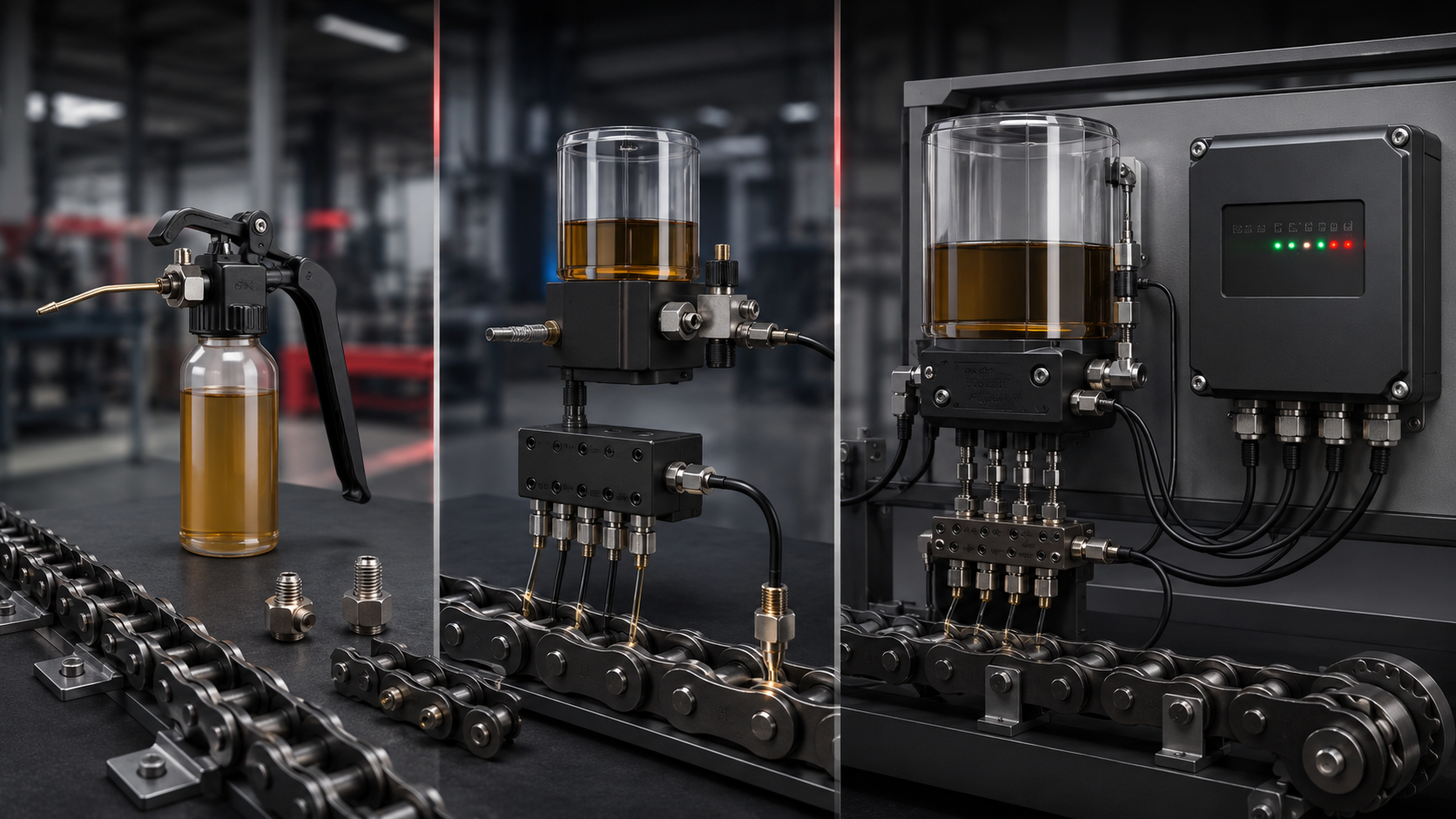
Table of Contents
1. Introduction
2. Overview of Core Industrial Chain Lubrication Modes
3. Working Principles and Application Scenarios of Each Lubrication Mode
4. Performance Data Comparison of Three Chain Lubrication Modes
5. Chain Lubrication Controller’s Role in Automated Lubrication
6. Industrial Chain Maintenance Best Practices for Different Working Conditions
7. Common Mistakes in Chain Lubrication Management
8. Conclusion
9. Industry FAQ
1. Introduction
Industrial chain lubrication is one of the most critical links in mechanical equipment maintenance.
Improper lubrication will cause chain wear, noise, jamming and even unexpected downtime.
At present, industrial chain lubrication mainly includes manual, single-act and continuous lubrication modes.
Many factories still adopt outdated lubrication methods, ignoring standardized chain maintenance best practices.
Reasonable matching of lubrication modes and chain lubrication controller can greatly extend chain service life.
2. Three Core Industrial Chain Lubrication Modes Overview
Different chain lubrication modes determine equipment operation stability and maintenance cost.
Manual lubrication relies on manual timing oiling, suitable for low-frequency equipment.
Single-act lubrication realizes one-time quantitative oil supply through simple mechanical control.
Continuous lubrication is a full-automatic working mode controlled by professional chain lubrication controller.
Each mode has obvious differences in precision, consistency and labor cost input.
3. Working Principles and Applicable Scenarios
3.1 Manual Chain Lubrication
Manual lubrication is the most traditional chain lubrication method in the industry.
Maintenance workers complete oil filling and chain surface oil distribution regularly.
It has no fixed oil supply standard, and the lubrication effect depends on manual experience.
It is only suitable for low-speed, intermittent operation and non-key industrial chains.
3.2 Single-Act Lubrication Mode
Single-act lubrication refers to quantitative and fixed-point one-time lubrication trigger.
It can avoid excessive oiling or insufficient lubrication caused by manual operation.
This mode is suitable for medium-speed equipment with periodic operation cycle.
But it cannot adjust oil supply dynamically according to real-time chain operating status.
3.3 Continuous Automatic Chain Lubrication
Chain automatic lubrication is the mainstream advanced solution for modern industrial equipment.
Supported by chain lubrication controller, it achieves uninterrupted micro-quantity oil supply.
The system can adjust lubrication frequency and oil volume according to load and speed.
It fully conforms to high-standard chain maintenance best practices for continuous production lines.
4. Industry Performance Data Comparison
The following test data is cited from 2025 CMMS Industrial Equipment Lubrication Official Report, comparing the actual operating indicators of three lubrication modes under 2400 hours of continuous equipment operation.
Detection Index | Manual Lubrication | Single-Act Lubrication | Continuous Automatic Lubrication |
Chain Wear Loss Rate | 8.7% | 4.2% | 1.3% |
Average Monthly Maintenance Time | 12.5 hours | 6.8 hours | 1.9 hours |
Lubrication Uniformity Score | 58/100 | 79/100 | 96/100 |
Unexpected Downtime Rate | 6.2% | 2.5% | 0.4% |
Data proves that continuous automatic lubrication guided by professional controllers has overwhelming advantages in stability and cost control.
5. Core Value of Chain Lubrication Controller
The chain lubrication controller is the core brain of automatic lubrication systems.
It can monitor chain running speed, operating load and temperature in real time.
The device automatically adjusts oil supply volume to avoid dry friction or oil accumulation.
It standardizes the whole process of industrial chain lubrication and realizes unattended maintenance.
6. Industrial Chain Maintenance Best Practices
For low-load intermittent equipment, single-act lubrication is the most cost-effective choice.
For high-speed and continuous production lines, continuous automatic lubrication is mandatory.
Regularly calibrate chain lubrication controller parameters to adapt seasonal temperature changes.
Clean chain surface dust and impurities before each lubrication cycle.
Form fixed lubrication inspection logs to avoid missing maintenance cycles.
7. Common Lubrication Management Mistakes
Many factories over-rely on manual lubrication for large-scale continuous production equipment.
Irregular oiling cycle leads to alternating dry friction and excessive lubrication.
Unmatched lubricant type and working temperature accelerate chain aging.
Ignoring controller parameter calibration causes poor automatic lubrication effect.
8. Conclusion
Three industrial chain lubrication modes have their own applicable industrial boundaries.
Manual and single-act lubrication suit low-demand and periodic equipment scenarios.
Chain automatic lubrication with intelligent controller is the best practice for modern industrial production.
Scientific lubrication mode matching can reduce wear, save cost and improve equipment stability.
9. Industry FAQ
Q1: What is the difference between single-act and continuous chain lubrication?
A1: Single-act lubrication completes fixed-point and quantitative oil supply in a single cycle without real-time adjustment. Continuous lubrication controlled by chain lubrication controller provides dynamic micro-oil supply according to equipment operation status, with more uniform and stable effect.
Q2: Why automatic lubrication belongs to chain maintenance best practices?
A2: Automatic lubrication avoids human operation errors, ensures long-term uniform lubrication, greatly reduces chain wear and downtime loss, and fits the standardized maintenance requirements of modern factories.
Q3: Is manual lubrication completely eliminated in industrial scenarios?
A33: Not completely. For low-frequency, low-speed and small-scale equipment, manual lubrication is more flexible and cost-effective, and still retains practical application value.
Q4: How to maintain the chain lubrication controller daily?
A4: Regularly check power supply and pipeline blockage, calibrate lubrication frequency and oil output parameters, clean sensor dust, and ensure real-time and accurate intelligent lubrication adjustment.